Tremorrag
live drawing performance
music/video: Pascal Battus
and Angie Eng
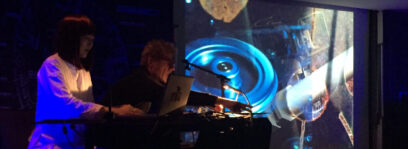
Tremorrag is a audio-visual performance inspired by synesthetic principals of sound, image and movement. This project focuses on the concept of the ability to visualize and hear movement which normally is felt rather than seen or heard. They explore the subtlety of movement and the poetics of gesture with live drawing.
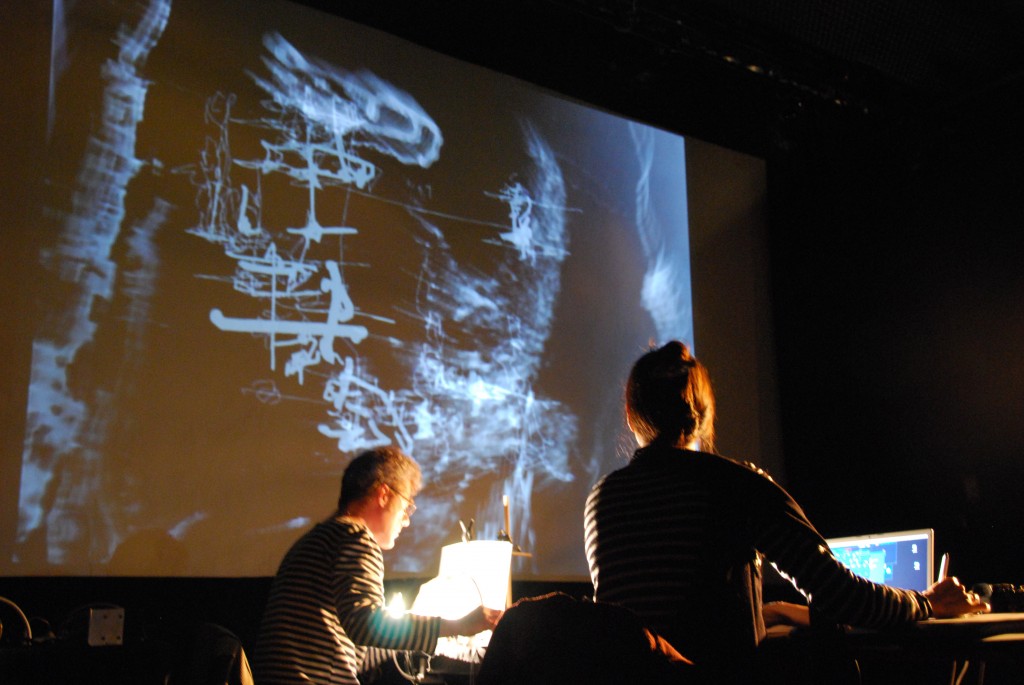
photo by Mr. Kentaro
For the video they use traditional pen drawing and digital design on a wacom tablet and video effects processing with Module8. The projected video is a mix between their black and white drawings and animations. Eng adds digital effects to her drawings turning static design into dancing calligraphy, swarms of insects and live abstract expressionism. The animations resemble early experimental film makers such as: Len Lye, Viking Eggeling, Oskar Fischinger, as well as artists: Henri Michaux, Cy Twombly and Frank Stella.
The collaboration was inspired by Battus’ series of abstract metro drawings in which he places his pen on paper and let the movement of the train dictate the composition, line and texture of the drawing. Eng noticed Battus’ work process was similar to her own even though Battus was working with sound and she with video. However both use small quotidian objects and motors to build suspense, emotion, contrast and even false narratives.
Eng, formerly trained as a painter in the tradition of abstract expressionism, recently began combining live drawing in her video performances. The drawing is used as emotional gesture to capture the energy or essence of a place, person or thing as well as symbolic narrative. She is interested in presenting drawing live because the instantaneousness of the medium allow a dynamic element that the audience witnesses as each choice is made. This demystification of process has been a recurring element in her peformance work. Thus the ‘liveness’ is also a considered an element with time, sound image, movement, emotion, symbol and form.
Using a micro-camera attached to his thumb, Battus captures extreme close ups that play with perspective and scale. Process is revealed to the audience using a second camera. Wider shots focus on his hand that holds the pen while the other moves the two pic up mics along the paper. With 2 camera angles, Battus can switch between two spaces that heighten our awareness of the the process as well as traveling to the virtual where one is absorbed by the abstract landscapes. Battus does not control visual composition, but relies on small motors that vibrate the paper to navigate the pen. Chance is a strong element of his visual composition and each drawing is very different each time it is performed.
The two draw in dialogue by responding to each other’s lines, movement as well as sound. At times, the visuals are secondary and marks are made as a result of the desired sound.
Their sound gestures and landscapes are similar to music concrete and noise music.They use pic up mics attached to their drawing tools. Thus the sound is the direct output of their live drawing and what you hear is the movement of their line. Eng attaches a pic mic to her wacom tablet so that what one hears as music is the sound of live drawing, or any movement she makes on the palette. Battus is has two pic up mics that he can move around the paper. His sound directly generated from pen and paper is as subtle as prairie wind and bellowing as a volcano erupting.
A sound artist in the tradition of music concrete, Battus is inspired by the minute sounds of rubbing objects, motors, metal, paper and plastic. Thus his music is inherently quite visual with a subtlety that requires an attentive ear.
